
Tennis elbow, also known as lateral elbow tendinopathy, is a frequent cause of pain on the outside of the elbow. At Physiodynamics, it is among the most common conditions we address.
Despite its name, tennis elbow affects many people who have never picked up a racquet.
Who Is Affected?
- Gym members and weightlifters
- Manual workers and tradespeople
- Office workers who use a mouse or keyboard repetitively
- Racquet sport athletes
- Parents who frequently lift young children
What Is Tennis Elbow?
Modern research indicates that tennis elbow is not simply inflammation or strain of a tendon. It is a load-related tendon condition, meaning the tendon becomes irritated when subjected to demands beyond its capacity. ¹
Importantly, no two cases are identical so precise diagnosis and tailored physiotherapy are crucial.
Anatomy of Tennis Elbow
On the outside of the elbow is the lateral epicondyle, a bony prominence. The common extensor tendon often involved in tennis elbow, attaches here.
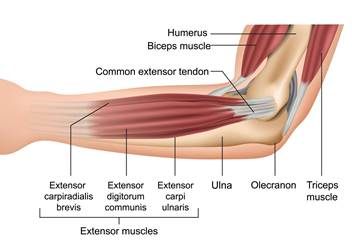
This tendon connects to forearm muscles responsible for:
- Lifting the wrist
- Stabilising grip
- Fine hand movements
- Lifting and carrying objects
The muscle most implicated is the extensor carpi radialis brevis (ECRB). Activities such as gripping, typing, weightlifting, carrying shopping or using tools activate this tendon.
When the load on the tendon exceeds its ability to recover and adapt, pain and sensitivity develop – this is lateral elbow tendinopathy.
Causes of Tennis Elbow
Tennis elbow occurs when the load on the tendon is greater than its ability to recover and adapt. This does not necessarily involve a dramatic event.
Two main scenarios can trigger the condition:
1. Repetitive Load Over Time
Many cases develop gradually. Small stresses repeated often – such as typing, mouse use, tool handling, racquet sports, gym gripping and manual handling – accumulate over weeks or months. Though each movement seems trivial the cumulative load may eventually overwhelm the tendon’s recovery capacity.
2. Sudden Increase in Load
Other cases follow a sudden spike in activity, such as:
- Returning to the gym after a break
- Rapidly increasing tennis or golf activity
- Starting a new job with more manual tasks
- Intense weekend DIY work
In these instances, the tendon has not had time to adjust to the new demands.
Why Age Matters
Tennis elbow is most prevalent among adults aged 35 to 55 years. As we get older:
- Tendon collagen becomes less elastic
- Healing slows down
- Recovery from load takes longer
This does not mean the tendon is worn out. Rather, the margin between load and recovery narrows with age. Recovery is also influenced by factors such as sleep quality, general health, fitness, smoking, metabolic health, stress levels and previous injuries. Two people of the same age may recover at very different rates.
Why Symptoms Vary
Tennis elbow is not a one-size-fits-all condition. Research shows it may involve several interacting systems:
- Tendon overload
- Strength and muscle inhibition
- Nervous system sensitivity
- Occasionally nerve-related irritation
Some people experience localised pain when gripping and mild strength loss. Others may have marked grip weakness, pain radiating into the forearm, heightened sensitivity and slower recovery. Radial nerve irritation can also occur, affecting treatment. ⁵
This variability makes a skilled physiotherapist’s assessment essential.
Healing Timeline
Recovery timeline is a key topic at Physiodynamics.
- Tennis elbow rarely resolves within 6 weeks
- Often persists beyond 6 months
- Commonly requires 12–18 months for full recovery ⁶
This does not mean pain lasts throughout the entire period. Tendon recovery is gradual and needs progressive loading. Understanding the natural course prevents rushing into injections or surgery and avoids frustration during rehabilitation.
Is Surgery Required?
Surgery should not be first-line treatment. Guidelines and studies show most people improve with structured physiotherapy and load management. ³,⁶ Surgery is reserved for persistent cases after prolonged, high-quality conservative management and even then results vary.
Most patients recover without surgery.
The Importance of Accurate Diagnosis
Lateral elbow pain is not always tennis elbow. Effective management depends on identifying:
- Primary pain driver
- Extent of tendon involvement
- Strength and load capacity deficits
- Neural contributions
- Proximal influences (neck, shoulder, thoracic spine)
- Work, sport and lifestyle factors
Accurate diagnosis requires advanced clinical reasoning and experience with upper-limb conditions. At Physiodynamics, our physiotherapists use evidence-based assessment, advanced tendon pathology knowledge, strength and conditioning integration, pain science and upper-limb biomechanics expertise. This ensures all contributing factors are addressed.
Missed drivers lead to persistent symptoms, while identifying and addressing them improves outcomes.
Physiotherapy Treatment for Tennis Elbow
Your management plan at Physiodynamics may include:
- Progressive tendon loading programmes
- Grip and forearm strength retraining
- Load modification strategies
- Neural mobility techniques (if required)
- Pain education
- Gym-based rehabilitation
- Return-to-work and return-to-sport planning
Our focus goes beyond short-term pain relief – we aim to restore strength, capacity, confidence and long-term resilience. By integrating advanced strength and conditioning principles, we bridge the gap between injury recovery and full performance.
Why Choose Physiodynamics for Tennis Elbow Treatment?
- Individualised treatment plans
- Evidence-based approach
- Expertise in upper-limb conditions
- Strength and conditioning integration
- Clear recovery timelines
- Honest advice regarding injections and surgery
We appreciate that lateral elbow pain can be frustrating and persistent. With the right diagnosis and structured progression, outcomes are excellent.
Book a Brisbane Physiotherapy Assessment
If you are suffering from outer elbow pain, grip weakness or ongoing tennis elbow symptoms, an early assessment can significantly improve your recovery.
References
- Coombes BK, Bisset L, Vicenzino B. Management of lateral elbow tendinopathy. BMJ. 2015;350:h111.
- Bisset L, Coombes BK, Vicenzino B. Lateral epicondylalgia. J Orthop Sports Phys Ther. 2015.
- Lucado AM et al. Clinical Practice Guideline: Lateral Elbow Pain. J Orthop Sports Phys Ther. 2022;52(6):CPG1–CPG50.
- Schabrun SM et al. Corticomotor excitability changes in lateral epicondylalgia. Brain. 2012.
- Fernández-Carnero J et al. Radial nerve mechanosensitivity in lateral epicondylalgia. Pain Med. 2009.
- Smidt N et al. Natural course of lateral epicondylitis. Ann Rheum Dis. 2006;65:1256–1261.